RDFa is W3C standard for encoding knowledge on the internet from everyday products we purchase through e-commerce sites, to names and anyone associated with whomever.
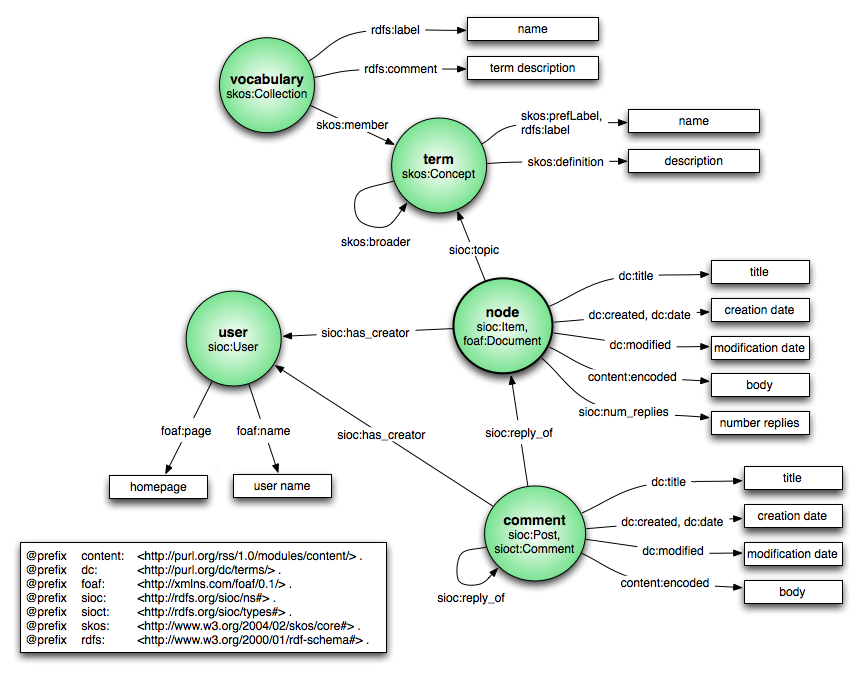
RDFa (Resource Description Framework – in – attributes) is a W3C Recommendation which allows embedding meta data within Web documents. RDFa is W3C standard for encoding knowledge on the internet from everyday products we purchase through e-commerce sites, to names and anyone associated with whomever. Today's web major search engines, including Google and Yahoo!, are moving aggressively trying to capture structured data. The release of Drupal7 nodes will now output RDFa data in core. With that being the case, upgrading from Drupal6 to Drupal7 will require a few changes to your page.tpl.php files.
The Semantic Web means that computers do the browsing and sorting for us. This enables computers to seek out knowledge distributed throughout the Web at a faster rate than an individual could process. To use an analogy, the current Web is a decentralized platform for distributed presentations while the Semantic Web is a decentralized platform for distributed knowledge.
There are numerous Drupal sites that contain vast amounts of structured data, the data residing on these sites contain a wide range of topics. However, that structure is hidden deep in Drupal's database and does not surface to the HTML code generated by Drupal. As a result, search engines can't pick up viable information, and fail to include it in their world-wide product database.
New standard for the Semantic Web
There should not be any question in mind about the depth of knowledge and information available on almost any given topic on the web today. However, the current Web has its limits in terms of what search engine spiders and other computers are capable of associating certain characteristics with certain topics. For example, Wikipedia, which might convey a lot of information to the human reader, but to the computer displaying the page only sees presentation markup. To that extent the computer makes sense of HTML, images, Flash, etc., it's almost always for the purpose of creating a presentation for the end-user (the ones who will be reading the content). The real content however resides in the knowledge that the files are conveying to the reader.
The term Semantic relating to the Semantic Web is not that computers are going to understand the meaning of anything, but that the logical pieces of meaning can be mechanically manipulated by a machine toward useful ends. An easy way to understand the concept of the Semantic web is to picture it as a web of databases.
One “semantic” website publishes a database about a product line, for example, with products and descriptions, while another publishes a database specializing in product reviews. While a third site for a retailer publishes a database of products that are currently in stock. The semantic part of the web takes all three databases and combines them so that a computer could simultaneously use three data sources to help the end-user, the consumer in this example, make a better purchasing decision.
The semantic web does not only apply to products and consumer reviews but provides a way for information to be easily accessible with a lot more flexibility. As technology and information around us changes at a rapid pace, the semantic web ensures that the end-user has the most accurate and up-to-date information available at his or her disposal.