Looking for a way to pass a few hours and be creatively inspired at the same time? This WebGL experiment may just do the trick.
The advancement in GPU (Graphical Processing Unit) technology is a big a deal. Today's high powered GPUs comes with more number-crunching capabilities than many CPUs. However, the web, which is still static for the most part, hasn't fully caught up to this growing phenomenon. As a result the end user is commonly stuck in slow low-quality 2D graphics. But that is about to change with WebGL.
WebGL in a nutshell is:
... a cross-platform, royalty-free web standard for a low-level 3D graphics API based on OpenGL ES 2.0, exposed through the HTML5 Canvas element as Document Object Model interfaces.
WebGL brings plugin-free 3D to the web, implemented right into the browser. Major browser vendors Apple (Safari), Google (Chrome), Mozilla (Firefox), and Opera (Opera) are members of the WebGL Working Group.
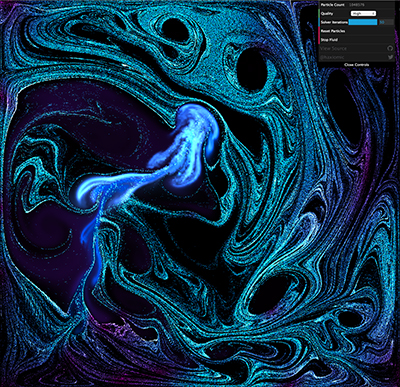
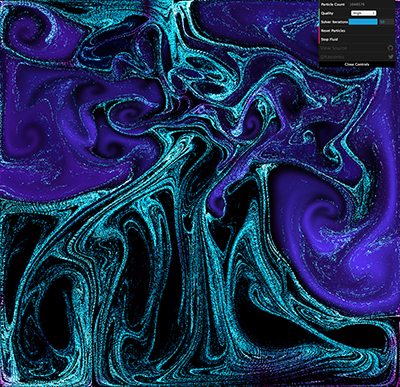
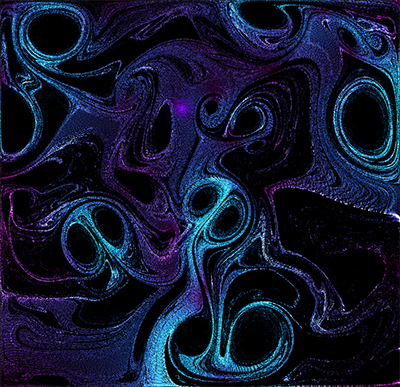
This website created by George Corney, and written in Haxe, is an experiment of WebGL and the power that it possesses. Feel free to experiment with the project yourself and create some stunning particles, akin to oil paintings, coloured by the magnitude of their velocity.